Reading The Body Language in Hockey
Body language is 50% of communication in hockey. Learn how Pro Ambitions teaches young players to read opponent feet and positioning to develop elite hockey IQ and gain a competitive edge.
June 30, 2026
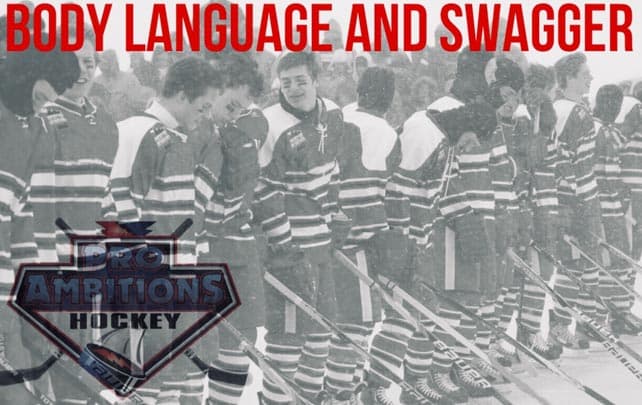
People use on average 50% body language and 50% verbal language when they are communicating.
Hockey is the same.
Reading the game is a skill, and reading bodies is a big part of it. The players who develop this early are the ones who seem to always be in the right place at the right time. It is not luck. It is learned.
Reading Your Opponent's Body and Feet
Watching your opponent's feet and chest to assess where they are going is one of the most important skills in hockey. The feet tell you the truth. A player can fake with the puck, fake with their eyes, but their feet and hips almost always tell you where they are actually going. Once you train yourself to see it, you cannot unsee it.
Start by watching the chest. It points in the direction a player is moving before they actually move. Then drop your eyes to the feet. Are they planted? Are they already shifting weight? That split second of information is the difference between being a step behind and being right on them.
This takes repetition. You are not going to pick it up in one practice. But if you start developing this habit at a young age, it becomes instinct by the time the game speeds up at higher levels.
Learning the Subtle Nuances Early
Pick up the subtle nuances of body language at a young age. The earlier you start, the more time the brain has to process and store those reads. Young players who are taught to observe, not just react, develop a level of hockey sense that cannot be faked.
This is not just about defense or winning pucks. It applies to reading your own teammates too. Knowing where a linemate is going before they get there turns a decent pass into a great one. The whole game opens up when you start reading bodies instead of just watching the puck.
At Pro Ambitions, we introduce this as a curriculum skill early on because it builds the foundation for everything else. A player who sees the game through body language has a head start on hockey IQ that carries them through every level they play at.
Difference Maker in Development
Body language reading is a curriculum skill that develops hockey IQ and game awareness.
It separates players who are physically talented from players who are actually effective. You can have a player with a great shot and strong skating who still gets beaten consistently because they are not reading the play. Then you have a player who is not the biggest or fastest, but they are always in position because they are watching and processing constantly.
Coaches notice this. Scouts notice this. The players who make smart reads under pressure stand out, because not enough players invest time in developing that skill. It is one of the less glamorous parts of the game, but it is a real separator.
Set Goals and Train With Purpose
Do not go through life without goals.
Set goals for the season. Plan training for the summer. The Summer Hockey Growth Spurt is significant for all hockey players, from youth to pros. It is evident who did what over the summer, even at the NHL level, in the early weeks of a new season.
Body language and hockey IQ are exactly the kind of skills you can develop in the summer when you have time to focus. Off-ice training, film study, and skill sessions are all opportunities to work on how you see the game, not just how you skate or shoot. Players who use the summer with intention come back in September looking like a different player.
If reading the play is a weakness, make it a target. Identify it, work on it, and track your progress. That is what setting goals actually means.
→ View All Pro Ambitions Camps and Programs
Frequently Asked Questions
How do you read body language in hockey?
Start by watching the hips and chest of your opponent rather than focusing only on the puck. The chest points in the direction a player is about to move, and the feet reveal whether they are shifting weight or staying put. It takes deliberate practice over time to make this a natural read, but the earlier you start, the faster it becomes instinct.
At what age should youth hockey players start learning to read body language?
We introduce this skill at early developmental levels. There is no reason to wait. Young players absorb habits quickly, and reading body language is a habit more than anything else. Starting early means a player has years of reps building that awareness before the game gets faster and the windows get smaller.
Can reading body language actually improve a player's hockey IQ?
Yes, it is one of the core ways hockey IQ is built. Hockey IQ is essentially your ability to process information quickly and make good decisions under pressure. Reading bodies gives you more information faster, which means better decisions. It also applies to reading teammates, which makes you a better passer, a better linemate, and a smarter player overall.
Why do so many players neglect this skill?
Most players focus on the visible, measurable stuff: skating speed, shot power, stickhandling. Body language reading is harder to measure and easier to skip. But the players who invest in it consistently show up with better positioning, better anticipation, and longer careers. The work that is hardest to see is often the work that matters most.
Apply It On The Ice
Ready to Put This Into Practice?
Pro Ambitions runs the largest youth hockey camp in North America. Train with coaches who wrote articles like this one.