Executing What You Practice in The Game
Discover how Pro Ambitions Hockey bridges the gap between practice and game-time performance. Coach Jeff Serowik shares how to build confidence executing new skills when it counts.
June 30, 2026
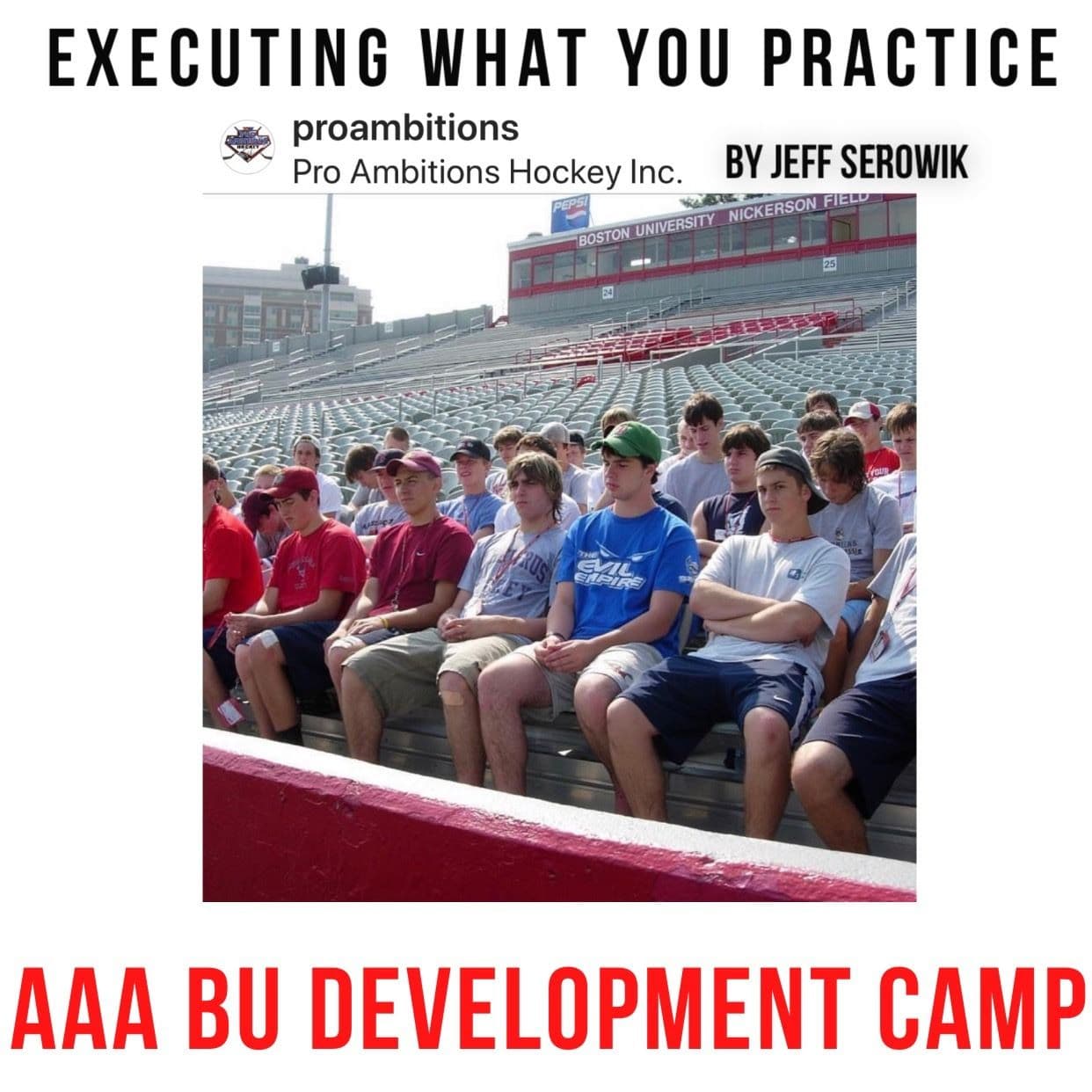
What We Train At Camp
We work on a lot of stick and scoring skills at camp. That means stickhandling under pressure, finishing in tight spaces, and making decisions faster than you're comfortable with. These aren't drills you do once and forget. They're building blocks we stack on top of each other all week.
The goal isn't just to look good in drills. The goal is to carry those skills into live play where everything gets harder and messier and more real.
Executing Skills When It Actually Counts
We want you to execute these moves in our battle scrimmage play at camp. That's the test. Anyone can look smooth in a stationary drill with no one on them. The real question is whether you can pull that move off when a defender is breathing down your neck and the puck is bouncing.
This is where most players stall out. They learn a skill in practice, it looks great, and then they get into a real situation and they freeze. We train you to close that gap.
The "Robot Coach" Problem
I know personally that some seasons I or my kids have had what I call "The Robot Coach," where you feel nervous to try things knowing you will get yelled at if you don't stay perfectly in what I call the "coach's lane." That kind of environment shuts players down. It teaches kids to play scared instead of playing smart.
There is a fine line on this topic, I realize this. Structure matters. Systems matter. But if a kid never feels safe trying something new, he stops developing. He becomes a robot himself. He does exactly what he's told and nothing more, and that ceiling gets low fast.
I've seen it at every level. The most creative players I played with weren't the ones who followed every instruction to the letter. They were the ones who had coaches who gave them room to make mistakes and figure things out. That freedom has to be earned, but it also has to be given.
How We Build Confidence To Try Moves In Games
Kids today can watch stickhandling experts on YouTube and mimic their moves at home over and over again until they become proficient at them in their own right. That's actually a great thing if you use it the right way. Watching is step one. Doing it in your driveway is step two. Doing it in practice is step three.
I encourage those kids to start executing those moves first in practice. Get the reps in when the stakes are low. Let it feel awkward. Let it fail a few times. That's the process working exactly how it should.
Then bring it into games. You don't skip steps. You earn the right to try it in a game by putting in the work before the game. That sequence matters.
Pushing You Out of Your Comfort Zone
We will push kids out of their comfort zone. We will train players in new and innovative ways to approach scoring and tactics to win your battles. Comfort zones are where skill development goes to die. If everything feels easy, you're not getting better.
We will challenge the way you think about puck possession, about where to be on the ice, and about how to create offense from nothing. Some of it will feel unnatural at first. That's the point. Your brain and your hands need to be stressed to adapt.
Repetition Is The Only Way
Repetition. Repetition. Repetition. Until you can pass the puck to yourself through your legs. That's not a joke. That's the standard. Skills don't become automatic because you tried them three times. They become automatic because you did them three thousand times.
When something is truly locked in, you stop thinking about it. Your body just does it. That's where you want to live in a game, operating on instinct so your mind is free to read the play and make smart decisions. You only get there through reps.
Unbiased Eyes, No Judgment
Like I always say, unbiased eyes. No judgment, but we will push the envelope. At camp, we're not your team's coach. We're not tied to a system or a roster or a win-loss record. We see you for what you are right now and what you could be. That perspective is valuable.
We're going to tell you the truth about what we see and then we're going to work to fix it. That's the deal.
--
Frequently Asked Questions
Why is it so hard to use my skills in games when I can do them fine in practice?
Practice is a controlled environment. Games are chaotic. The pressure is different, the speed is different, and everything is happening faster than your brain is used to. The fix is to replicate pressure in practice as much as possible, which is exactly why we use battle scrimmages at camp instead of just running drills. The more you practice under stress, the smaller the gap gets between what you can do in practice and what you can do in a game.
What should I do if my coach won't let me try new moves in games?
Earn the right first. Show your coach in practice that you can execute the move consistently. Coaches get more comfortable giving players freedom when they've seen the skill work under controlled conditions. Talk to your coach after practice, not during a game. Come in with the right attitude and ask where they want to see improvement. That conversation goes a lot further than just trying things and hoping for the best.
How much time should I spend practicing stickhandling on my own outside of team practice?
As much as you can fit in consistently. Short daily sessions beat one long session a week every time. Even fifteen to twenty minutes a day in your driveway or basement adds up fast over a season. Pick two or three moves and work them until they're automatic before you add more. YouTube is a legitimate resource if you use it to actually go practice, not just watch.
At what age should players start working on advanced stickhandling and scoring skills?
There is no age that is too young to work on puck skills in a fun and low-pressure way. The earlier you develop soft hands and comfort with the puck, the better. What changes with age is the tactical layer. Younger players should focus on getting comfortable with the puck from every angle. As players get older, we start layering in the decision-making side, knowing when to use a move, where to create space, and how to read defenders.
Apply It On The Ice
Ready to Put This Into Practice?
Pro Ambitions runs the largest youth hockey camp in North America. Train with coaches who wrote articles like this one.